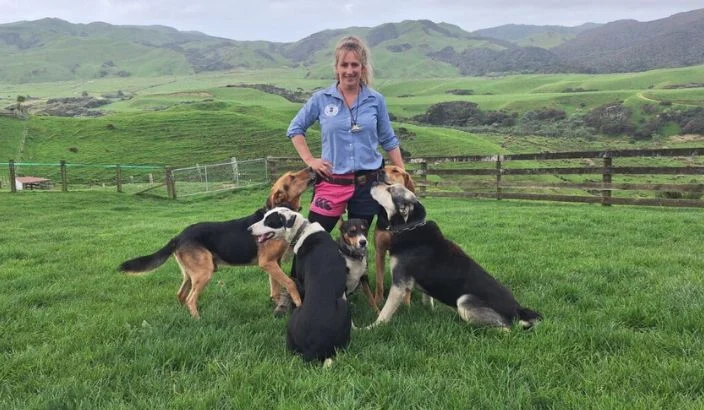
When Golden Bay sheep and beef farmer Elspeth Miller first got into dog trialling, it wasn’t something she set out to do, “I never imagined myself as a dog trailer — I just sort of stumbled into it,” Ellie laughs.
Ellie’s journey into dog trialling began with the generosity of a neighbour and good mate. Jock Wyllie—an experienced trialist and president of the Marlborough-Nelson region of dog trials—gifted her two older, well-trained Huntaways. Though they were given primarily as working dogs for the farm, both had been trialled by Jock himself to ‘open level’, the highest competitive grade in the sport. In reality, what he offered Ellie was far more than a pair of good dogs—it was an opportunity.
“I was pretty fortunate to start out with really good dogs,” she says. “But I was a total amateur, so if anything went wrong, it was on me—not the dogs. It was a great way to begin—no battling with the dogs.” That good start soon turned into a real passion.
“I’ve always been a keen stock person and enjoy working stock quietly and calmly,” Ellie explains. “Dog trialling requires you to use good stockmanship, read what the animals will do next, and keep both your dog and the sheep under precise control.
I like that part of it.” Ellie adds that she has a very competitive nature, which works well for the trials. “It’s challenging, but when I have a good run, it’s really exciting - honestly, it’s quite addictive. I’ve definitely caught the dog trial bug.”
After a few years of sticking to local trials, Ellie began travelling further afield with a tight-knit crew of friends—making the nine-hour trip from Kaihoka, northwest of Golden Bay, to places like Mayfield and Methven.
“I probably wouldn’t go that far without them,” she says. “We have good banter, talk through the runs, and turn it into a bit of a road trip.” Despite a busy life farming with her husband, Pax, and raising young children, Ellie still makes time for dog trials many summer weekends.
“Thankfully, I’ve got a very understanding husband who stays back and looks after the farm and the kids. He knows how much I love it and that it makes me happy” she says. While she doesn’t train as much as she’d like, trialling has lifted the standard on-farm. “You expect more from your dogs, and that carries through—they’re better farm dogs for it.”
Like any sport, dog trialling comes with its tough days. “It’s disappointing when your dog isn’t listening or when you make mistakes yourself because of nerves or pressure,” she admits. “But it does happen to everyone. The good runs make up for the bad ones and inspire you to keep improving.” Ellie is modest about her skill level, still calling herself an amateur—but she has big goals.
“One day, I’d love to qualify for the nationals. That would be a real achievement for me. I’ve got a long way to go, but I’m really inspired to get both my dogs and me better and better.”
To anyone thinking about giving dog trialling a go, Ellie is full of encouragement. “It’s a great way to improve your dog skills and connect with others,” Ellie explains. “I imagined it was an old boys’ club, but I was very wrong. There are lots of young people and plenty of women involved now. It’s got a great social side to it too.”
Anyone interested in attending or getting involved in the next dog trials can contact Ainslie Wilson, Tākaka Dog Trial Club secretary, on 021 265 6911 or email mndogtrials@gmail.com.
