
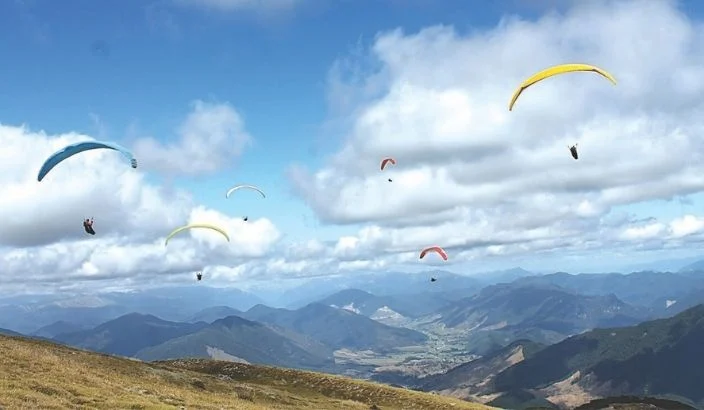
Nelson will welcome pilots from across the world for the New Zealand Paragliding Nationals and Open at the end of the month.
Organisers say roughly 60 paragliders will hit the skies between 31 January and 6 February, creating a spectacular sight for those on the ground around the region.
The nationals were last hosted here in 2021 and the fact it is returning places Nelson firmly on the map as an outdoor and adventure destination.
“Events like this reinforce the region’s reputation for active lifestyles, innovation and world-class natural flying sites,” says organiser Jakob Kleinmans alongside Peter Alison.
Competition headquarters will be at McCashin’s in Stoke, where pilots, organisers and volunteers meet daily for briefings and results. On flying days, expect to see convoys heading up local hills, including Barnicoat, Tākaka Hill and Mount Murchison, as pilots are transported to launch sites.
“Nelson also has a strong and welcoming paragliding community; many of whom volunteer their time to help run the event and support visiting pilots.”
Paragliding is a form of free flight where a pilot launches on foot using a lightweight fabric wing. After take-off from a hill or mountain, the pilot is lifted by rising air and can stay airborne for minutes or even hours, sometimes covering long distances.
Paragliders stay aloft by using natural lift – thermals, which are columns of warm rising air, and ridge lift, which is wind pushed up by hills. Pilots steer with brake handles and are suspended comfortably in a harness beneath the wing.
Although it is an adventure sport, paragliding is highly regulated, with trained pilots, certified equipment and careful weather assessment.
Paragliding competitions are not about aerobatics or tricks. They are about strategy, efficiency and reading the weather. Each day, pilots are given a task – a route in the sky defined by invisible turning points, similar to boats rounding buoys during a regatta. Pilots choose when to start and how to fly the course, deciding where to climb in lift and when to glide on.
Some reach the goal quickly, while others score points for the distance they manage to fly. Every pilot carries a GPS tracker, and results are calculated from these recorded flights.
While Jakob and Peter say it’s difficult to predict exactly where and when will be the best time to view the display from the ground due to weather conditions, they recommend keeping your eyes to the sky to catch a glimpse of the colourful spectacular.
Final flight decisions are made each morning and updates can be found here.

