
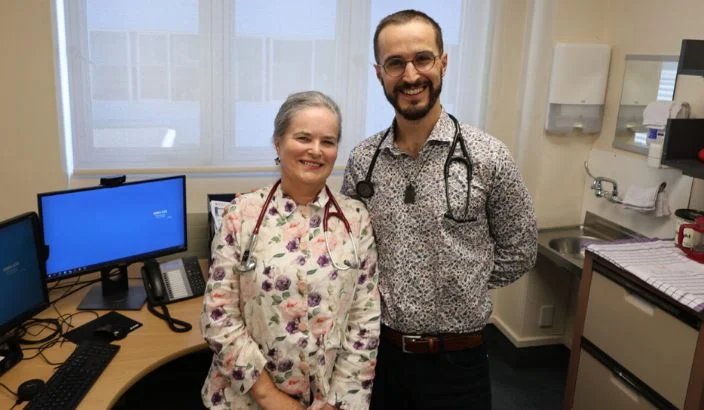
The year was 1992. Jim Bolger was the Prime Minister and Shortland Street made its debut on New Zealand television.
It was also the year Dr Pamela Hale walked through the doors of Nelson Hospital for the first time, beginning a career that would span more than three decades in the region and more than 40 years in medicine.
After nearly 34 years at Nelson Hospital and 43 years working in medicine overall, Pamela has retired from her role as a specialist physician.
Originally from Christchurch, Pamela graduated from the University of Otago before undertaking specialist training in Christchurch, Tauranga, Waikato and Dunedin, with a short stint in the United Kingdom.
She was awarded her Fellowship of the Royal Australasian College of Physicians (FRACP) in 1991. That same year, she and her husband moved to Nelson with their young family, where she commenced work at Nelson Hospital in 1992.
Her husband’s job brought the family to the region.
“I came to Nelson for a year to try it out. That’s what I agreed to do, and I’ve never left,” quips Pamela, who completed her last-ever clinical shift on 16 January.
Back in 1992, she was only the second female specialist in Nelson, following child psychiatrist Dr Kay Bradford.
“When I arrived here, I had a three-year-old and a baby, and then I subsequently had another baby.”
She was appointed part-time on the condition that she would take on two roles that no one else wanted to do – supervising the junior doctors and the diabetes clinic. She embraced both roles, supervising many clinicians who are now senior medical officers at a time when there were just five physicians at Nelson Hospital and no registrars. She also became Nelson’s local endocrinologist, a role she carried single-handedly for approximately 25 years.
While endocrinology formed the outpatient portion of her work, her primary role throughout her career was as a general physician.
Pamela says Nelson Hospital and medicine in general have changed immensely over the years.
“When I first arrived, there were hardly any doctors, and we had hardly any inpatients. Over the years, the geriatric population in the region and the number of patients being admitted have grown enormously.
“There’s a lot more different treatments available than there were 40 years ago when I started, so the amount of knowledge that a physician needs to know has increased because there are so many more treatments and names for diseases.”
Alongside her clinical work, Pamela also held several leadership and governance roles, including head of department (medicine) and clinical director of medical services. Beyond Nelson, she served three elected terms on the Medical Council of New Zealand, chairing its health committee and supporting doctors whose medical conditions affected their ability to practise.
Reflecting on her career, Pamela says one of her proudest achievements was completing specialist training while raising young children at a time when the profession offered little flexibility for women.
“When I graduated from medical school, a third of the graduates were women, but hardly any of the specialists were women, because of the problem of going through training during your childbearing years – and also the fact that women couldn’t really get into those training programmes because of the sexism.
“Nowadays, two-thirds of the medical students graduating are women.”
The decision to retire did not come easily, she says.
“I’ve been working towards this for a couple of years, and I’m ready to finish, although it’s sad. It’s been the hardest decision I’ve ever made in my life.”
Looking ahead, Pamela plans to spend more time with family, including her grandchild in Nelson, and to pursue hobbies such as dressmaking and golf. A formal farewell will be held in mid-February.
“It has been a real privilege to be a doctor and look after people. Total privilege.”

