
To walk over the bridge to Jester House is to leave behind the real world and enter somewhere make-believe. Britt Coker talks to the husband and wife imagineers who have created, over three decades, the wonderland they always wanted.
Photos: Tessa Claus
“Have you forgotten your tail? You can borrow one of ours.” Say many things of Judy van den Yssel-Richards but never that she is miserly with spare appendages. This (optional) accessorising of tails and hats is just part of the run of the mill madness you’ll find at Jester House. In 2026, it is a place of whimsy.
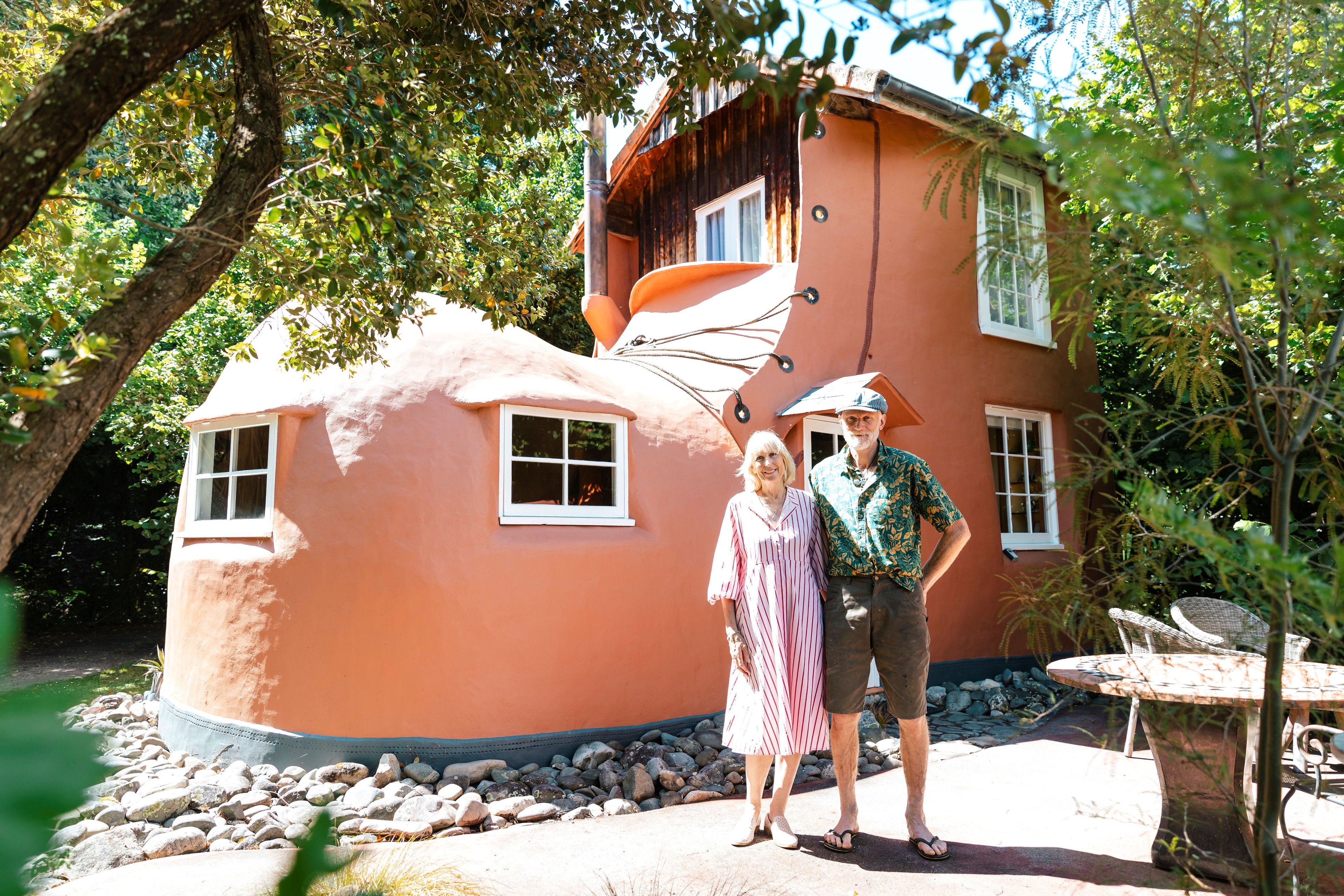
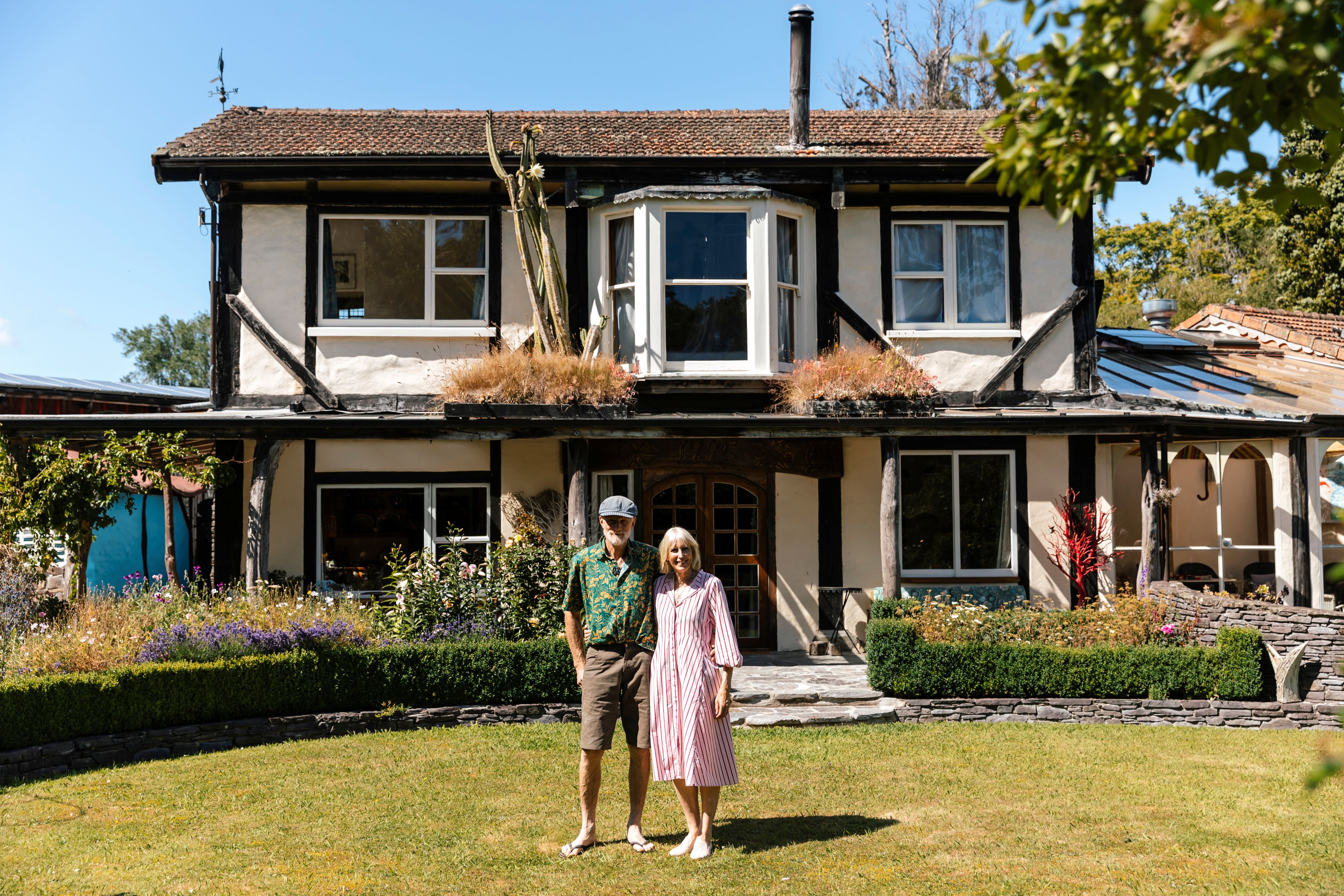
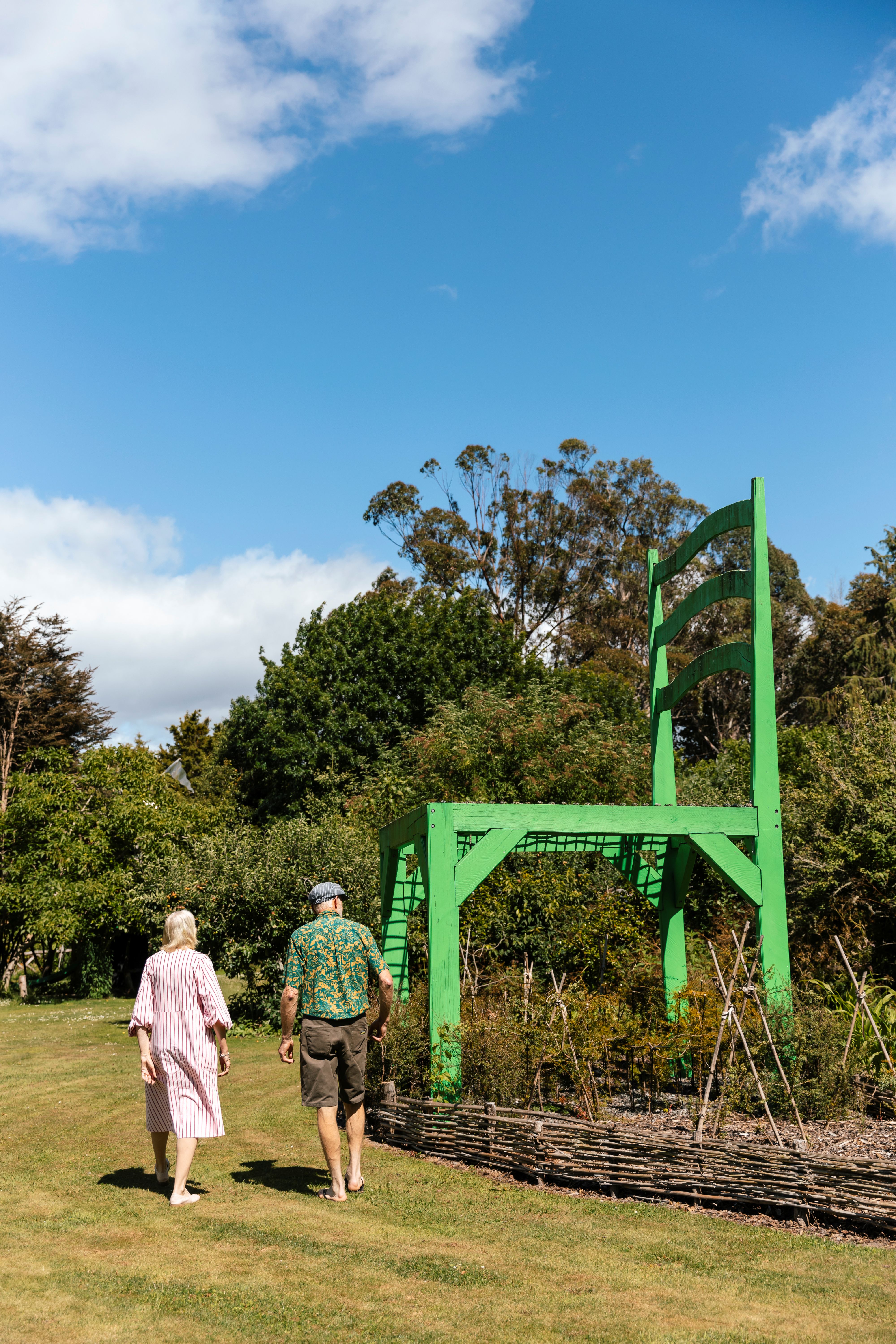
Notable features include a giant’s chair, a house-sized boot, an enchanted garden, life-sized animal sculptures in the perennial beds, a DOC hut folly, and a jester outlined with native trees (viewable from the air). It is hard to imagine that the property once consisted of just a small cottage, 2.4 hectares of ‘half flat, half hill’, and a boundary stream, minding its own business. That was way back in 1991 when Judy and husband Steve Richards bought the place.
They came up from Canterbury with big dreams and little experience - or awareness of the book cover they were being judged by. Steve says, “I grew up in Nelson, but we had no idea that we were hippies. When we came, we moved from Glen Tunnel, I had a big red beard, and Judy wore long, flowing dresses. Two beautiful children, aged two and four. Didn't own a pair of jeans. And Motueka was hippie central, and so then people had this perception of who and what we were.”
Judy elaborates further. “People would go, ‘Oh you are that hippie place, and we would say, we’re not hippies, and they would say, yes you are.” She feigns defeat. “Oh, ok.” But what others thought of them ultimately didn’t matter because buying the property was what they wanted. Judy explains. “We just spent two and a half years travelling and being with each other 24/7 and our daughter was born in Holland, so she travelled with us, and we were always together, and then all of a sudden he's just leaving every day [for work, in Canterbury]. So we decided we'd get rid of that stress. So we got rid of one stress, and we got a whole huge cauldron.” She laughs. Sanely, I think.
The plan was to create a profitable business on the land. Something that they could do together, and that was a bit different. Judy says for their customers they wanted to, “take them out of the ordinary, just so that they could for a short period of time, just forget all the other stuff going on in their life, and immerse themselves.”
To manifest this, the couple settled on a dream of a café in the countryside. With not much of a start-up budget, homemade and handmade features became the name of the game. But while it may have initially been driven by financial prudence, the honest, rustic vibe has become a Jester trademark and something that resonates for a couple who feel connected to the land.
The boundary stream had long been home to eels, but their presence on the property has now become as entwined with Jester House as much as the eels are with each other. The very first promotional flyer advertising the new café mentioned only one resident eel as the previous owner had said there were eels
in the creek but, the couple had only ever seen one, and they thought, “We can’t put ‘tame eels’ and have people say there aren’t eels, there’s only an eel.” It turns out that one tame eel is not much of a drawcard. Or more to the point, wandering on to a stranger’s property to have a coffee was too disconcerting for most locals. “It was really hard in the beginning.” Judy reflects. “In 1991 between Motueka and Richmond there was no other [country] cafés,, we were the first. At one stage I counted there were 21, but it's reduced a bit now.”
A lot of those early customers were British. The couple theorise that it’s because in the UK, people have grown up traipsing confidently through landowners’ pastoral properties courtesy of public paths and pagan trails that are centuries old. Meanwhile, Kiwis would wander across the Jester bridge, see a few deckchairs on the lawn, and turn back not wanting to intrude even though the sign said, open. Some days, nobody came. The couple resorted to parking cars on the roadside to make the place look busy.
Steve: "We didn't know anything about business. I mean, if we'd known about business, we probably would have stopped because...” Judy agrees. “Yeah, honestly, we would have”. Steve again “… we weren't making money.”
Luckily, drinking coffee in a stranger’s enchanted country garden soon became a popular trend, and the months and years that followed became very busy. Nowadays, Fridays see more cars than car spaces, more children than tails, and more tiger riders than tigers. But never more magicians than magic. They reached their five-year plan in four. But the lead-up to that point involved a lot of time focusing on the business while the house was neglected.
Steve reminisces, “We were living in the back of the café. There was a three-by-four-metre bedroom with a double bed and bunks.” There were four of them, but only three chairs, so, one child was always on the floor or a parent’s knee. “For Harriet's eighth birthday, we moved into the house, but it was a barn, so there was no internal walls upstairs or downstairs. It was just a concrete floor, bare earth walls, stairs, a bare wooden floor upstairs.”
Judy remembers looking at a photo someone took of the children in the house at the time, “I was like, Oh, my God, we live in a brown paper bag, we’ve got to do something.” (They did something. There were at least four dining chairs and as many walls, when I visited).
The tame eels have been a massive drawcard over the years. Not just one, more like one or two dozen. They are tame in the sense that they will eat out of your
hand the fresh meat available from the café but wild in the sense that they will also nibble the hand that feeds them if given half a chance. Or your toes, if you absentmindedly stand in the water to harvest peaches off an overhanging branch.
One of the most iconic features on the property is their B&B shaped as a boot (“It's essentially a concrete boat upside down,” says Steve). The idea of providing somewhere for guests to stay was born out of a wish to be able to be more fully present with visitors as the busyness of the café was preventing opportunities for that. But also, to give couples a place to reconnect with each other as it is a philosophy that is personally important to Steve and Judy.
Judy explains, “Before we got married, we had to talk to a priest, and he was amazing, and he said to us, your married life will go along like this.” She holds out her hands, closely parallel. As she continues, the hands move away from each other and back again.
“There are the two of you, and you're close together, and it's great. And then you have children, and you go out like that in business or whatever you choose to do. You’ve got your jobs and stuff, and it is really important, because I see so many people that when the children have gone and they come back together, they don't know each other anymore. So during that time, you have to build bridges and reconnect with each other and make sure you do that.’ And so that's really stuck in our heads.”
I can see this in the way they share their stories with me. One person’s sentence is full of the other’s clarifications, additions, and sometimes, another sentence entirely. I am witnessing two people used to spending all their time together without getting heartily sick of each other. That’s not always possible, no matter what a priest says.
Of all the seemingly random features on the property, the giant-sized green chair in the garden is one of the most deliberate. Steve ran for Tasman mayor in several local elections and while he was unsuccessful getting the top job, “We had to have a green seat in Tasman,” allowed him to get what he wanted, his way. Even the overarching Jester theme was inspired by the logo of the McGillicuddy Serious Party, a political party most active from 1984-1999, which Steve represented as a candidate. The party’s policies centered around Funism (their maxim: the most fun for the most people) and ridiculing the incumbent party’s policies with tongue-in-cheek contrariness. That purposeful silliness of the McGillicuddy’s is the Jester House modus operandi. Many people don’t know of Steve’s political aspirations though, so they arrive thinking the couple are self-realised comedians out to entertain like a typical court jester, not an atypical politician. “It's not that we are funny, particularly,” says Steve. “I don’t think I’m a very funny person at all.” Judy agrees (some might suggest, too quickly), adding, “People say, ‘Oh, so you're the Jester?’ No, no, we hold the spirit.”
Many of the garden features have just arrived on the back of a trailer. They didn’t ask for the life-sized Arnold Schwartzentiger, the oversized penguin, nor the stone or the wooden sculptures by well-known local artists. Steve theorises, “We've created the space, and it just attracts incredible benevolence around it.”
Now about those tails. Judy reckons, “It started because someone left a tail here. It was in the toy basket, and kids were putting it on and I thought, ah. So I made a whole lot. And parents would wear them - like a guy had one around his head hanging down like a ponytail. And one little girl with every tail we had around her like a skirt. Gorgeous. You don't have to do anything for it, you just put them out there, and they get used, or not, and they invariably always get used.” Steve adds, “Everything has an inspiration from something… the hardest thing to think of is the thing you haven't thought of. And so you see something, and it sparks the beginning of the journey.”
Once the core creative elements started to shine through, the ‘expect the unexpected’ model of whimsy and wonderland bedded in, the advertising tapered away as the customer numbers did the reverse. And for almost 30 years, seven days a week, Judy and Steve ran a popular café/restaurant and a giant boot as a B&B, then finally, in 2020 they shifted down a couple of gears to only open on Fridays. Actually, it was more of a screech to a halt. They had planned the change of opening hours to happen on April Fool’s Day - the jester theme always top of mind - but a week earlier the whole nation closed. When they reopened for business, Fridays-only was an easy reset.
Over the years, the couple had created a long rose-covered screen to provide some natural privacy for their family. It was past its prime by 2020, so during lockdown they took it down. A task Judy describes as cathartic, “Because it was the opening up of our lives and such a huge change from having to keep your private life s separate from your business life.”
From seven days, down to one is a big gear change. Even despite the restricted privacy, some people would miss that kind of buzzy atmosphere where endless happy chattering and squeals of delight were the sound bed to your day. But running a café/restaurant is already hard work without it being next to your house, without your days off having curious garden strollers mere metres from your privacy (and if not for the thorny rose, even closer than that). Plus, there was the small matter of a breakdown.
Steve reflects. “In 2019 we had staff troubles and spinning out of control issues. We were overwhelmed and burned out, and it was like something seriously has to change or we won't exist anymore as a café or as people. And so we decided then that we would change to one day a week.”
Steve remembers his emotions when they switched. “Total relief. Total relief, particularly for me, I was in the midst of a breakdown. Spinning around and crying uncontrollably, something serious is going on. It's like, that's not how I operate. And all of a sudden we were joyous – it’s fun to be back in the café.”
With 35 years and the headspace to reflect, the couple talk fondly about the generations of people who have had their pictures taken on the back of Arnold Schwarzentiger, now bringing along their own children for additions to the photo album. The Friday before they had a 91-year-old visitor, while at another table, a 101-year-old blew out some candles.
Birthdays, weddings, funerals and just-because gatherings. Almost everyone is welcome, or as Steve puts it, “We’re not ageist or sexist or racist, we're personalityists. We don't like arseholes.”
They have an easement on their land now for cyclists on the Great Taste Trail to ride through the property. The tree-lined path the couple planted years ago, is a brief respite on a summer’s day. The couple sell their orchard fruit from a roadside stall and oversee a book exchange that Steve built. Bigger than it needs to be because, he admits, ‘I don’t do small, very well.”
A future project is a small scriptorium where one can sit when one wishes to copy (by hand) ancient, illustrated manuscripts and less extraordinary books. Printing presses are for wimps. The scriptorium’s central spiral staircase has already been rescued from someone’s paddock and is now lying quietly until the remainder of the building plan is nutted out. Steve is the big-picture person, Judy provides the practical detail. There’s plenty of other ideas on the list too. More than there is time, according to Steve. “It gets to a stage where you think, I can't think of anything else because I've got too many ideas already.”
A limit to their creations - this couple? Surely, they jest.

