In June 1960, the Government held an Industrial Development Conference aimed at encouraging industries that could process New Zealand or imported raw materials from their crudest form through to a finished product. Nelson appeared poised to benefit, with plans underway for a processing mill. The Hon. Walter Nash announced the mill would be in production in 1961, but the timing proved unfortunate. Soon after, the investors withdrew from the scheme.
A fresh proposal for a cotton spinning and weaving industry in Nelson emerged that June, signalling the mill might proceed after all. However, the change of Government later in 1960 triggered a review of the cotton mill agreement. By December there was a renewed assurance of support.
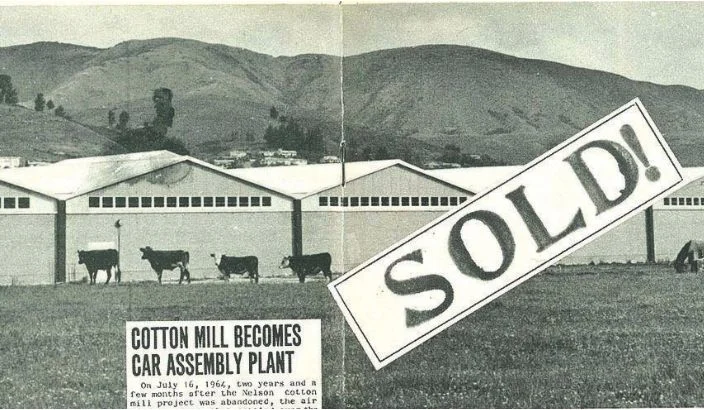
Construction began with hopes the mill would be operating by 1962, but ongoing conflict between the investors and Government resulted in the entire scheme being abandoned in July that year. The partially-finished buildings and 27 acres of land lay vacant, never used for their intended purpose. Various attempts to repurpose the site were investigated, but each fell through.
Just over two years later the Standard-Triumph organisation purchased the half-completed mill, shifting its vehicle assembly plant to Nelson and providing a welcome economic boost for the district.
The Nelson Motor Vehicle Assembly Plant was opened in May 1966 by the Minister of Finance. The plant produced Triumph Herald saloons and estate cars, Triumph 2000 saloons, 15 cwt and 20 cwt Leyland vans, and 2-ton Leyland and Albion trucks. Crated vehicle parts arrived from England to be assembled on site.
Between 1972 and 1988 ownership changed hands several times. In the mid-1970s the New Zealand Motor Corporation took over the plant, and in August 1988 Honda New Zealand purchased NZMC's thirteen retail dealerships, its franchise and the Annesbrook assembly plant. Honda invested heavily, including millions on a new paint shop in 1991, and in 1995 added an engine assembly line, the first and only one in New Zealand.
However, the National Government’s 1997 decision to remove tariffs on imported vehicles rendered the plant unviable. After 33 years of production it closed on 21 August 1998, with about 190 people losing their jobs. Around 4,500 people had worked at the plant over its lifetime, producing 160,406 vehicles.
Today, the car museum, Mitre 10 Mega and the shops at the Junction occupy the original site.
